
Mga salita sa bukidHandy tools
Farm words glossary
Palay or bigas, cavan or kilo, habagat or amihan - plain explanations of the farm and sale words used in the Philippines and across the REALM network.
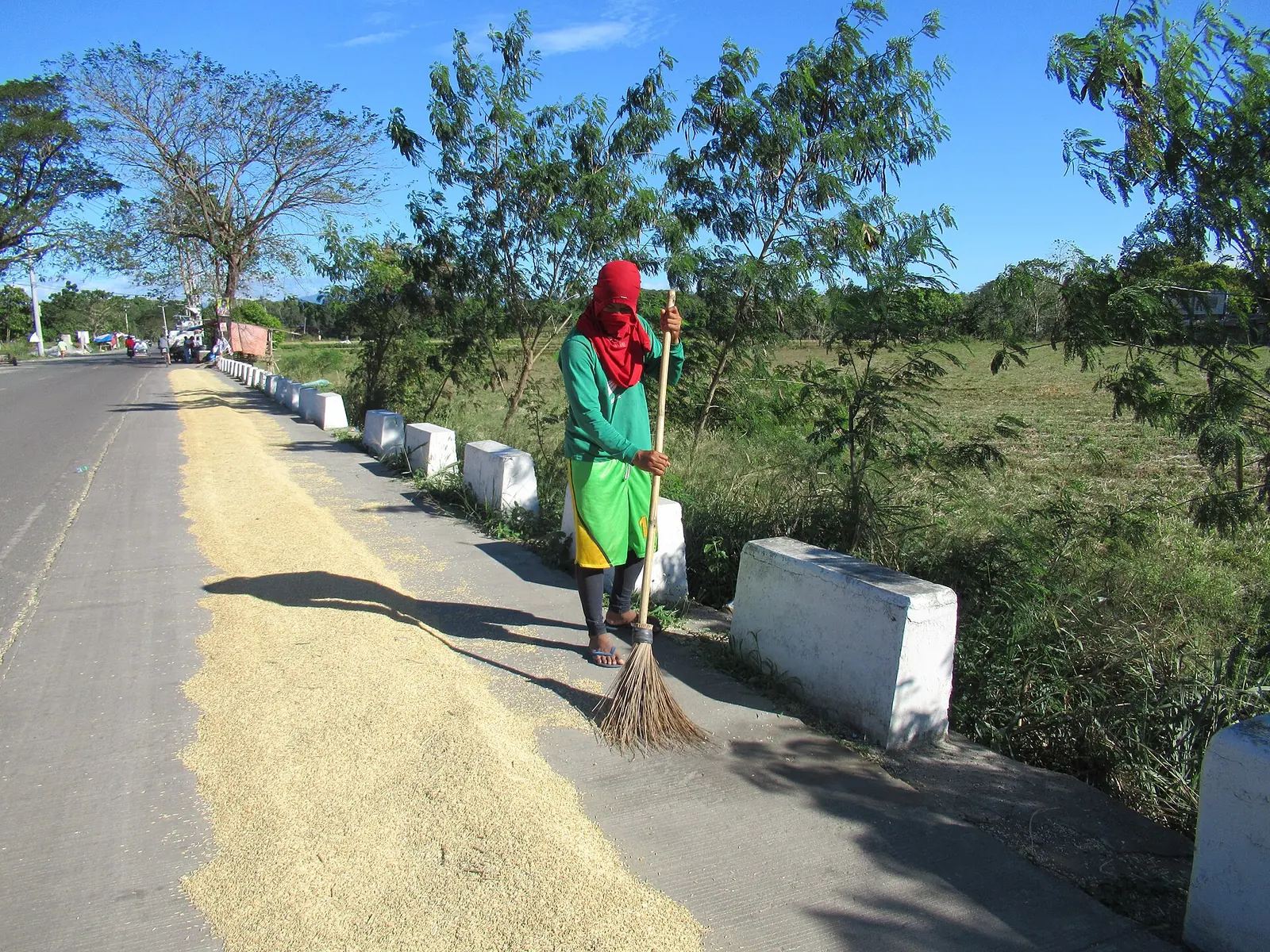
Drying palay in Angat, Bulacan. Photo: FBenjr123, CC BY-SA 4.0, via Wikimedia Commons

71 words so far. Each one shows where it is mostly used and what it is called elsewhere. Missing a word? Tell us and we'll add it.
A
- Acre
-
Used in: America, Canada (and older titles in Australia and NZ)
A unit of land area: about 0.405 hectares, or 4,047 square meters. One hectare is about 2.47 acres.
- Agistment
-
Used in: Australia, New Zealand
Paying to graze your livestock on someone else's land for a while, usually charged per head per week.
Also called: Custom grazing or pasture lease (America, Canada)
- Amihan
-
Used in: Philippines
The northeast monsoon, usually from about November to February. It brings cooler, drier air to much of the country but rain to the eastern coasts.
Also called: Northeast monsoon
- ASF (African swine fever)
-
Used in: Philippines and worldwide
A viral disease that kills pigs and has no cure. It does not make people sick. It spreads through sick pigs, pork products, and contaminated vehicles, clothes and equipment, so biosecurity and reporting sick pigs to your veterinarian matter.
- AUM (animal unit month)
-
Used in: America, Canada
A grazing measure: the forage one mature cow (traditionally about 1,000 lb, with or without a calf) eats in a month. Used to set stocking rates and grazing leases.
B
- Backgrounding
-
Used in: America, Canada, Australia
Growing weaned calves on pasture or forage until they are heavy enough to go to a feedlot or be finished.
- Backyard farm
-
Used in: Philippines
A small household farm that keeps a few hogs, chickens, goats or cattle - as distinct from a commercial farm. Much of the country’s livestock is raised this way.
Also called: Smallholder
- Balut
-
Used in: Philippines
A fertile duck egg incubated for about 16 to 18 days and then boiled, a famous Filipino street food. Eggs set for balut that do not develop are sold as penoy; making balut needs drakes kept with the laying ducks.
Also called: Penoy
- Bangus
-
Used in: Philippines
Often called the national fish of the Philippines; raised in brackish and freshwater fishponds, pens and cages - Pangasinan, Bulacan, Pampanga and the Visayas are well known for it. Sold fresh, smoked (tinapa), deboned or as daing.
Also called: Milkfish (Chanos chanos)
- Barangay
-
Used in: Philippines
The smallest unit of local government in the Philippines - a village in the countryside or a district in a city. Many farm permits, certificates and advisories start at the barangay hall.
Also called: Village, local district
- Bayanihan
-
Used in: Philippines
The Filipino spirit of working together for the community, pictured in the old custom of neighbors carrying a family’s house to a new place.
- Bigas
-
Used in: Philippines
Rice after the husk (and usually the bran) has been removed by milling - the rice people buy and cook.
Also called: Milled rice
- Biik
-
Used in: Philippines
Filipino for a piglet. Backyard raisers usually buy biik at weaning and fatten them for sale as hogs (baboy).
Also called: Piglet, weaner
- Broiler
-
Used in: Philippines and worldwide
A chicken bred and raised for meat, usually harvested about four to six weeks after it arrives as a day-old chick (sisiw). Many Filipino growers raise broilers under contract for a company that supplies the chicks and feed.
Also called: Meat chicken
- Bushel
-
Used in: America, Canada
A grain measure. It is a volume, but grain is traded by a standard weight per bushel that depends on the crop - for example 60 lb for wheat and soybeans, 56 lb for corn.
C
- c/kg lwt and c/kg cwt
-
Used in: Australia
How Australian cattle and sheep prices are quoted: cents per kilogram of live weight (lwt), or of carcase weight (cwt) after dressing. Not to be confused with the American cwt (hundredweight).
Also called: $/cwt (America, Canada)
- Carabao (kalabaw)
-
Used in: Philippines
The swamp-type water buffalo of the Philippines. It still pulls plows and carts on many small farms and is also raised for milk and meat.
Also called: Water buffalo
- Carcase weight
-
Used in: Australia, NZ (spelled "carcass" in America, Canada)
The weight of an animal after slaughter and dressing (hide, head, feet and organs removed).
Also called: Dressed weight, hot carcass weight
- Cavan (kaban)
-
Used in: Philippines
A sack used as a trading unit for palay, rice and corn. It is usually counted as 50 kg, but sack weights vary, so always check what your buyer or miller uses.
Also called: Sack
- Clearing sale
-
Used in: Australia, New Zealand
An on-farm auction of machinery, tools, equipment and sometimes stock - often when a farm is sold, leased out or someone retires.
Also called: Farm auction or estate sale (America, Canada)
- Contract growing
-
Used in: Philippines
A grower raises animals, often broilers or hogs, for a company (the integrator) that supplies the young stock, feed and medicines and pays a fee per animal harvested, with bonuses or deductions written in the contract.
Also called: Contract growers, integrator
- Cwt (hundredweight)
-
Used in: America, Canada
In America and Canada, 100 lb (about 45.4 kg). US cattle prices are usually quoted in dollars per cwt. The old British hundredweight is 112 lb.
D
- Dispersal sale
-
Used in: Everywhere
The sale of a whole herd or flock, for example when a farmer retires or changes enterprise.
- Dressing percentage
-
Used in: Everywhere
Carcase weight divided by live weight, times 100. It varies with the animal, how full it was and how it is processed.
Also called: Yield
- Dry matter (DM)
-
Used in: Everywhere
What is left of a feed once all the water is taken out. Feed needs and feed tests are usually given in dry matter, so wet feeds like silage go less far per metric ton than hay or grain.
- DSE (dry sheep equivalent)
-
Used in: Australia
A way to compare the feed needs of different stock: roughly what one mature, non-breeding sheep needs to keep its weight. Larger or breeding animals count as several DSE.
Also called: Stock unit (New Zealand), animal unit (America, Canada)
F
- FCR
-
Used in: Everywhere
Kilos of feed used for every kilo of fish or meat produced. An FCR of 1.3 means 1.3 kg of feed for each kilo of fish harvested; the lower, the better.
Also called: Feed conversion ratio
- Feeder cattle
-
Used in: America, Canada
Young cattle sold to be grown out or fattened further, rather than for slaughter straight away.
Also called: Store cattle (Australia, New Zealand)
- Feedlot
-
Used in: Everywhere
A yard where cattle (or sheep) are fed a grain-based ration for a set number of days to finish them for market.
- Fertilizer analysis (N-P-K)
-
Used in: Everywhere
The numbers printed on a fertilizer bag: the percentage by weight of nitrogen (N), phosphorus (P), potassium (K) and often sulfur (S). Australian and New Zealand labels usually give P and K as the elements; American and Canadian labels give them as P₂O₅ and K₂O (P = P₂O₅ × 0.436, K = K₂O × 0.830).
Also called: Fertilizer grade (America, Canada)
- Finished cattle
-
Used in: Everywhere
Cattle that have reached market weight and condition and are ready for processing.
Also called: Prime or fat cattle (Australia, New Zealand), fed cattle (America)
- Freehold
-
Used in: Australia, New Zealand, Fiji
Owning land outright, with no end date - as opposed to leasehold, where you hold the land for a set term.
Also called: Fee simple (America, Canada)
H
- Habagat
-
Used in: Philippines
The southwest monsoon, usually from about June to September. It brings much of the rainy season’s rain to the western side of the country, and it can be made heavier by passing typhoons.
Also called: Southwest monsoon
- Hacienda
-
Used in: Philippines
A large agricultural estate, historically common in sugar areas such as Negros.
Also called: Estate
- Hammer price
-
Used in: Auctions everywhere
The winning bid when the auctioneer's hammer falls - before any buyer's premium, GST, VAT or other charges.
- Header
-
Used in: Australia
The machine that cuts, threshes and cleans grain crops in one pass. In America "header" usually means just the front that cuts the crop.
Also called: Combine or combine harvester (America, Canada, New Zealand)
- Hectare (ha)
-
Used in: Philippines, Australia, New Zealand, Fiji (and alongside acres in Canada)
A metric unit of land area: 10,000 square meters, or about 2.47 acres. 100 hectares make one square kilometer.
- Heifer
-
Used in: Everywhere
A young female bovine that has not yet had a calf (some markets also use it for a cow with her first calf).
- Hen-day production
-
Used in: Philippines and worldwide
Eggs laid per day for every 100 hens in the house. A flock of 1,000 hens laying 850 eggs a day is at 85% hen-day.
Also called: Lay rate, laying %
- Hours (engine hours)
-
Used in: Everywhere
How long a tractor, header or other machine has run, shown on its hour meter. Servicing, fuel use (liters per hour) and the value of used machinery are all measured in engine hours.
Also called: Hour meter reading
I
- iTaukei land
-
Used in: Fiji
Land owned by Fiji's indigenous landowning units. It covers most of Fiji and is generally leased (through the iTaukei Land Trust Board) rather than sold.
- Itik
-
Used in: Philippines
The domesticated duck raised across the Philippines, mostly for eggs that are sold fresh or made into balut, penoy and salted eggs. Flocks are often herded into harvested rice fields to glean fallen grain.
Also called: Pato, egg duck, Pateros duck
- Itlog na maalat
-
Used in: Philippines
A duck egg cured in a salt and clay (or salt and soil) paste or in brine for a few weeks, then boiled, often dyed red so buyers can tell it from a fresh egg.
Also called: Salted egg, red egg
K
- Kambing
-
Used in: Philippines
Filipino for goat. Many Filipino farms keep a small herd of does and a buck, often in a raised slatted house, and sell the kids for meat (for dishes such as kaldereta) or as breeders. Native goats are often upgraded with Boer or Anglo-Nubian bucks for heavier kids.
Also called: Goat; doe, buck, kid
L
- Lab-lab
-
Used in: Philippines
The mat of algae and tiny organisms grown on the bottom of a prepared and fertilized fishpond, a traditional natural food for bangus that lowers the bought feed needed.
Also called: Natural food
- Layer
-
Used in: Philippines and worldwide
A hen kept for eggs rather than meat. Egg producers usually buy ready-to-lay pullets at about four months old and keep them laying for a year or more before selling them as cull hens.
Also called: Laying hen, ready-to-lay pullet
- Leasehold
-
Used in: Everywhere
Holding land or a building for a set number of years under a lease, rather than owning it outright.
- Lot
-
Used in: Auctions everywhere
One item or group of items sold together at an auction, each with its own lot number.
M
- Marking % (lamb marking)
-
Used in: Australia, New Zealand
The number of young counted at marking (or branding) for every 100 females joined. Weaning % works the same way with the count at weaning, and scanning % with the young counted at pregnancy scanning.
Also called: Calf branding % or calf crop % (cattle; America, Canada)
- ME (metabolisable energy)
-
Used in: Australia, New Zealand, UK
The energy in a feed that an animal can use, usually given in megajoules per kilogram of dry matter (MJ/kg DM) on a feed test. It is used to compare feeds and to work out how much energy stock are getting.
Also called: Often compared with TDN or NE in America and Canada
N
- NAIT
-
Used in: New Zealand
The National Animal Identification and Tracing scheme: cattle and deer are tagged with RFID ear tags and registered, and their movements recorded.
- NLIS
-
Used in: Australia
The National Livestock Identification System: cattle carry electronic (RFID) ear tags, and sheep and goats are identified too, so animals can be traced from property to property.
P
- Paddock
-
Used in: Australia, New Zealand
A fenced area of a farm used for grazing or crops.
Also called: Field or pasture (America, Canada)
- Palay
-
Used in: Philippines
Rice as it comes from the field, still in its husk. It is dried and milled into bigas (milled rice). Farm-gate prices are usually quoted for palay per kilo or per cavan.
Also called: Paddy or rough rice (elsewhere)
- Passed in
-
Used in: Australia, New Zealand
When a property or item at auction does not reach the seller's reserve price, so it is not sold under the hammer. Talks with the highest bidder often follow.
Also called: No sale / bought in
- Pasture cover
-
Used in: Everywhere
How much pasture is in a paddock, usually in kilograms of dry matter per hectare (kg DM/ha). Farmers estimate it by eye, with a pasture ruler or a rising plate meter; the cover left when stock move out is called the residual.
Also called: Herbage mass, feed on offer (FOO)
- PTO (power take-off)
-
Used in: Everywhere
The splined shaft on a tractor that drives implements like mowers, balers and pumps. Check the PTO speed (540 or 1,000 rpm) matches the implement.
R
- Reserve price
-
Used in: Auctions everywhere
The lowest price the seller will accept. It is usually kept secret; if bidding does not reach it, the item is passed in.
S
- Silage and haylage
-
Used in: Everywhere
Grass or crops cut green and stored airtight (in pits, bunkers or wrapped bales) so they ferment and keep. Haylage is drier than silage; hay is dried in the paddock before baling.
- Station
-
Used in: Australia, New Zealand
A large pastoral property that runs cattle or sheep, often over thousands of hectares.
Also called: Ranch (America, Canada)
- Steer
-
Used in: Everywhere
A male bovine castrated when young, usually raised for beef.
Also called: Bullock (for older steers in Australia, NZ and Britain)
- Stocking rate
-
Used in: Everywhere
How many animals a piece of land carries over time - for example DSE per hectare in Australia or AUMs per acre in America.
T
- Tag-ulan and tag-araw
-
Used in: Philippines
Tag-ulan is the rainy season (usually about June to November) and tag-araw the dry, hot season (usually about March to May). Timing differs between regions.
Also called: Wet season and dry season
- Three-point linkage
-
Used in: Australia, New Zealand
The hydraulic arms on the back of a tractor that lift and hold implements. Categories (1 to 4) must match between tractor and implement.
Also called: Three-point hitch (America, Canada)
- Tonne
-
Used in: Philippines, Australia, New Zealand, Fiji, Canada
A metric metric ton is 1,000 kg. A US "short" ton is 2,000 lb (about 907 kg) and a British "long" ton is 2,240 lb (about 1,016 kg).
Also called: Metric ton
- TSW (thousand seed weight)
-
Used in: Everywhere
The weight in grams of 1,000 seeds. It differs between crops, varieties and seed lots, so it is used to turn a target number of plants into a seeding rate in kg/ha.
Also called: Seed weight, 1,000-kernel weight
U
- Ute
-
Used in: Australia, New Zealand, Fiji
A light vehicle with an open tray or tub at the back - the everyday farm vehicle.
Also called: Pickup or pickup truck (America, Canada)
W
- Water rate
-
Used in: Everywhere
How much spray mix (water plus product) a sprayer puts out per hectare or acre, usually in L/ha or gal/ac. The product label often gives the range to use; calibrating the sprayer checks what it really puts out.
Also called: Carrier volume, spray volume, gallons per acre (America)
- Weaner
-
Used in: Australia, New Zealand
A young animal recently taken off its mother's milk - for cattle usually around 6 to 10 months old.
Also called: Weaned calf or lamb (America, Canada)
Y
- Yearling
-
Used in: Everywhere
An animal about one to two years old. In Australian cattle markets yearlings are young cattle sold at lighter weights.
No word matches that yet. Try the site search, ask the Chat Assistant (bottom right) or tell us which word to add.
General explanations only - rules, fees and measures differ between countries, states and sale yards. For a sale or contract, check the terms with the agent, auctioneer or seller.
Need the numbers too?
Convert hectares and acres, pesos per kg and per cavan, metric tons and short tons, spray rates and more with our free farm unit converter.